Spotting a Card Skimmer at the Gas Pump or ATM
Skimmers are built to look like they belong. A few physical checks before you insert your card catch most of them, and internal skimmers change what you should watch for instead.
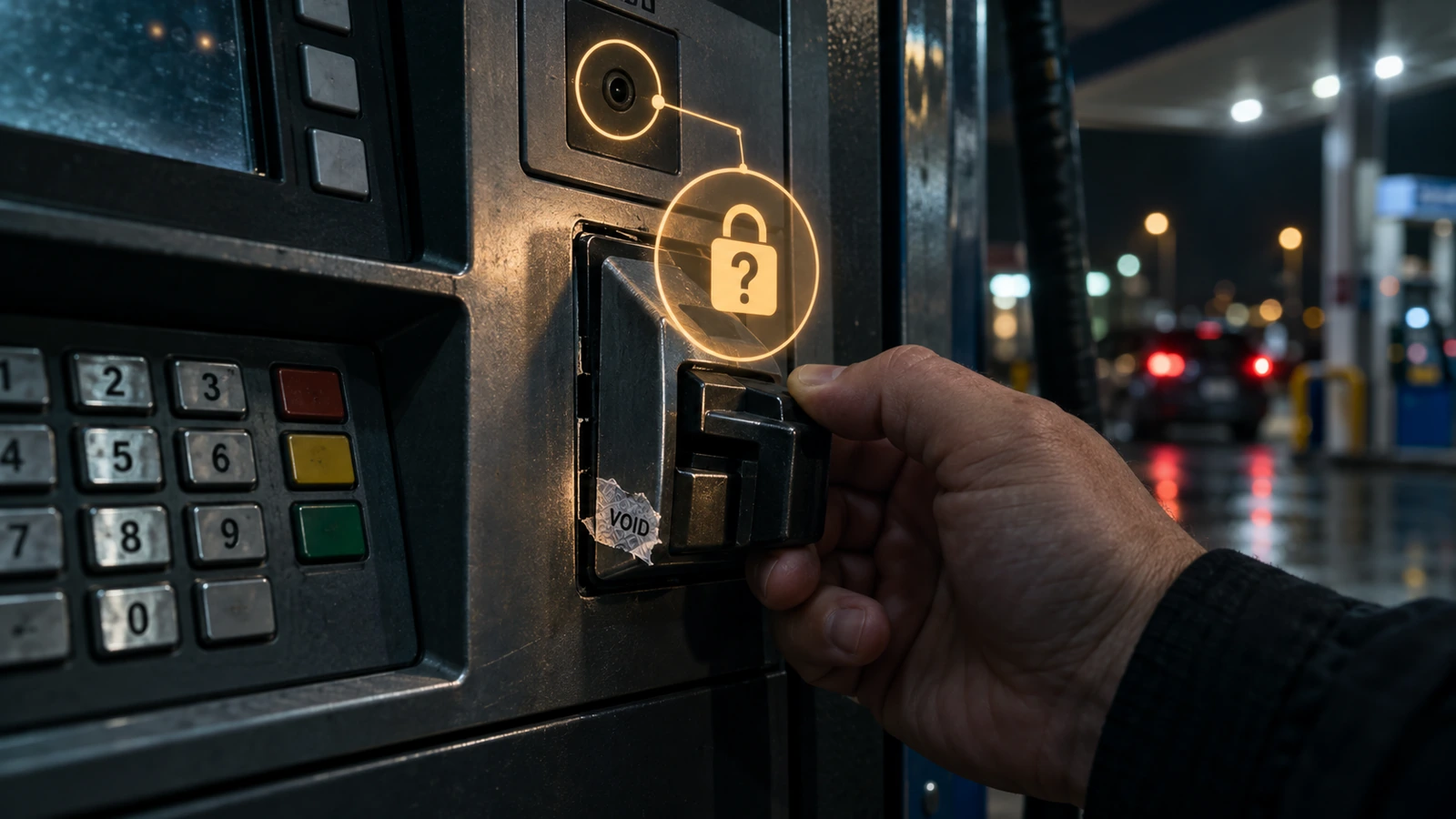
A card skimmer's entire design goal is to look like it belongs on the machine it's attached to — which is exactly why a quick glance rarely catches one, but a specific, fast physical check almost always does.
Check the security seal first
Many gas pumps have a small security seal or sticker across the panel that would need to be removed to access the card reader internally. If that seal is broken, shows a "VOID" pattern, or is visibly missing where nearby pumps have one intact, treat that pump as compromised and use a different one — this single check catches a meaningful share of physical tampering attempts before you ever touch the card reader itself.
The wiggle test on the card reader
Before inserting your card, grip the card-reader slot itself and gently pull or wiggle it. A factory-installed reader is bolted firmly in place and won't move; an overlay skimmer fitted on top of the real reader is comparatively loose and can shift, rattle, or come partially free under light pressure. Do the same brief check with the keypad if it feels unusually thick or raised compared to what you'd expect.
Compare it to the pump or ATM next to it
Skimmers are often installed on just one or two machines in a row, not every unit at a location, so a quick comparison is genuinely useful: if the card slot, keypad texture, or panel color on your machine looks different from the one next to it, that's worth treating as a red flag even if you can't articulate exactly what looks wrong.
| Sign | What it suggests |
|---|---|
| Broken or missing security seal | Panel was opened; possible internal tampering |
| Card reader wiggles or feels loose | An overlay skimmer may be fitted on top of the real reader |
| Keypad feels thicker or sits higher than expected | A PIN-capture overlay may be present |
| Small pinhole above the reader angled at the keypad | Hidden camera capturing PIN entry |
| Sticky residue or glue marks near the card slot | Signs of a recently installed or removed skimmer overlay |
Pinhole cameras capture what your hand doesn't hide
A skimmer alone only captures card data; pairing it with a small pinhole camera aimed down at the keypad captures your PIN too. Check for any small hole positioned above or beside the keypad angled downward, and as a low-cost habit regardless of whether you spot anything, cover the keypad with your other hand while entering your PIN — it defeats a hidden camera whether or not you ever actually find one.
Internal skimmers are the harder case
A more sophisticated skimmer is installed inside the machine, attached to internal wiring rather than as an external overlay, and is effectively undetectable through any external physical check — criminals with a universal maintenance key for a specific pump or ATM model can install these without leaving any visible external sign. Because internal skimmers can't be caught by inspection, the more reliable defense against this specific variant is choosing payment terminals with tap-to-pay or chip capability when available, since both are harder to skim than a magnetic-stripe swipe, and monitoring your statements closely regardless of how careful your physical inspection was.
- □ Check for a broken, missing, or "VOID"-marked security seal on the panel before using a pump.
- □ Wiggle the card reader and keypad gently to feel for looseness compared to a firmly mounted factory unit.
- □ Compare your machine's card slot and keypad to the one next to it for any visible difference.
- □ Look for a small pinhole camera positioned above or beside the keypad.
- □ Cover the keypad with your hand while entering your PIN, regardless of whether anything looked suspicious.
- □ Prefer tap-to-pay or chip transactions over a magnetic-stripe swipe when the terminal supports it.
Location patterns worth knowing
Skimmer installation tends to cluster around less-supervised locations — outdoor pumps at the edge of a station's lot rather than the ones nearest the attendant window, and standalone ATMs in low-foot-traffic areas rather than ones inside a staffed bank branch. This isn't a guarantee that supervised locations are risk-free, but the physical checks matter more, not less, at an unattended or edge-of-lot machine, since a criminal has more uninterrupted time to install and later retrieve a skimmer there.
What to do immediately if you find one
If your physical check turns up a genuinely suspicious card reader or keypad, don't attempt to remove it yourself — report it to the location's staff or owner immediately, and separately contact local law enforcement, since a skimmer in place is active evidence of an ongoing crime that officials may want to investigate and potentially trace. Use a different, verified machine for your own transaction rather than the one you just flagged.
Monitoring your statement is the backstop, not a substitute
Even careful physical inspection won't catch every skimmer, particularly internal ones, so treat regular statement monitoring as a required second layer rather than something you only do after suspecting a problem. Many card issuers offer real-time transaction alerts by text or app notification — turning these on gives you a much faster window to catch and report fraudulent use than waiting for a monthly statement, since skimmed card data is sometimes sold and used weeks after the actual skimming occurred.
A note on debit cards specifically
A skimmed debit card carries more immediate risk than a skimmed credit card, since a fraudulent debit transaction pulls directly from your bank account rather than a credit line, and federal liability protections for unauthorized debit card use are time-sensitive — reporting quickly matters more with a debit card than with a credit card, where you generally have stronger and less time-pressured liability protection. If you have the choice at a pump or ATM you're at all uncertain about, using a credit card rather than a debit card limits your direct exposure if a skimmer does turn out to be present.
Questions specific to Spotting a Card Skimmer at the Gas Pump or ATM
Does using tap-to-pay instead of swiping actually protect against skimmers?
Yes, meaningfully — tap-to-pay and chip transactions use dynamic, encrypted data for each transaction, which is much harder for a traditional magnetic-stripe skimmer to capture and reuse compared to swiping the card's static magnetic stripe.
Can a skimmer be detected just by looking at the machine, without touching it?
Sometimes, if the overlay is poorly fitted or the security seal is visibly broken, but a well-installed overlay skimmer can look convincing at a glance — the physical wiggle test catches cases a visual-only check would miss.
What should I do if I think I used a compromised card reader?
Contact your card issuer immediately to flag the card and monitor for unauthorized transactions, and consider requesting a replacement card number even before any fraudulent charge appears, since skimmed data is sometimes sold or used weeks after it's captured rather than immediately.
Are ATMs or gas pumps more commonly targeted by skimmers?
Both are common targets, and the specific location context matters more than the machine type — outdoor, less-supervised pumps and standalone ATMs in low-foot-traffic areas tend to see more skimmer activity than machines inside a staffed, monitored location.